annual Report
2024

Introduction

Leadership Message
A foundational principle of the Consortium is working together to achieve lasting structural market change. We represent our collective goals to manufacturers, standard setting organizations, and federal agencies to build the needed infrastructure to support these market changes, serving as an honest broker with stakeholders. CEE is a 501c3 consortium of investor-owned and municipal utilities, national labs, nonprofit Demand Side Management and market transformation program administrators, and supportive state and federal agencies. Members are responsible for approximately $7 billion of the $9 billion budgeted annually for demand side investment in the US and Canada and serve nearly 100 million electric customers and 50 million gas customers. CEE’s public benefit mission is to serve administrators of electric and gas demand side programs that actively support customers in their journey to manage energy wisely and reduce their carbon footprints. CEE channels our members’ strategic objectives in order to gain strength in numbers and transform markets. We also strive to create North American platforms that can be adopted by program administrators to benefit local programs that influence consumer behavior and choices. Today, more than ever before, our customers need credible guidance on how to navigate the myriad of options for cost-effectively making their homes and businesses "green."
Since 2011, CEE has expanded our focus to the integrated benefits of efficiency and load management with the recognition that time and location of savings matter. Energy savings in jurisdictions with increasing intermittent renewables and emerging reliability challenges stemming from a growing economy and the electrification of buildings and transportation must be cognizant of periods of ramping peak demand. In 2023, this philosophy has resulted in several major "wins" for the champions of energy efficiency and demand flexibility working together at CEE:
- Industry test procedures and certification programs for efficient residential and commercial HVAC and water heaters that employ open standards communications and perform a verifiable, predictable demand response.
- Collaboration and deliberation with US Department of Energy (DOE), US Environmental Protection Agency (EPA), California Energy Commission (CEC), and Natural Resources Canada (NRCan) to build the consumer and grid value propositions, coupled with standard definitions of demand flexibility in buildings through minimum codes and standards as well as voluntary programs.
- Exploring the opportunity that dual-fuel HVAC systems offer in service of comfort, reliability, resiliency, decarbonization, and affordability.
- Establishment of US federal tax credit performance levels for HVAC and water heating systems that promote efficiency, comfort, and automated load management, while moving the industry forward.
- Coordination with NASEO and state energy offices to maximize the impact of the multiple incentive structures within the Inflation Reduction Act.
- Supporting leading natural gas utilities who are working to reduce energy waste with super-efficient products and weatherization measures that reduce total energy use regardless of fuel type. These utilities are also working at CEE to scale successful demand response to reduce the need for new supply side infrastructure and to launch new clean energy initiatives such as district ground source heating systems.
Our annual report also details how the CEE Board of Director's 5-year strategic goals represent the consensus focus for CEE in today's evolving landscape. CEE's board represents a true cross-section of our industry including IOUs, municipal and crown-corporation utilities, statewide program administrators, and founding advocates.
Though the Consortium started with just one Initiative, our portfolio now includes 18 Initiatives addressing a wide breadth of industries, ranging from commercial heat pump water heaters to residential HVAC systems that leverage variable speed heat pump technology to reduce energy use and provide demand flexibility. Members understand that the time and location of savings are critical for meeting today's decarbonization and reliability objectives and are working directly with manufacturers to deploy systems capable of shedding, shifting, and delaying energy use. CEE Initiatives seek to reward market players whose leadership creates products and services of ever greater value to utility customers and systems and accordingly improves the livelihood of society.
Please read more about the incredible accomplishments from 2024. These range from homeowner and contractor guidance for ASHP Installations, to enhancing the scope of Commercial Water Heating, evolving SEM to include decarbonization goals, research into NEIs as well as several new reports from the Center for Equity and Energy Behavior.
At the Consortium for Energy Efficiency, leading United States and Canadian efficiency program administrators develop consensus-based strategies to accelerate adoption of cutting-edge energy efficiency, load management, and decarbonization solutions that benefit all customers and improve the reliability of energy delivery systems.
We invite you to review the highlighted work of 2024 and look forward to your engagement and support in the years to come.

JOHN TAYLOR
Executive Director
Member Listing
Program Administrators- Ameren Illinois
- Avangrid
- Berkshire Gas
- Connecticut Natural Gas
- New York State Electric & Gas
- Rochester Gas & Electric
- United Illuminating
- Avista Corporation
- Baltimore Gas and Electric Company
- BC Hydro
- Cape Light Compact
- Commonwealth Edison Company
- Consolidated Edison Company
- Consumers Energy
- DC Sustainable Energy Utility (DCSEU)
- DTE Energy
- Dominion Energy—Utah
- Duke Energy
- Efficiency Maine
- Efficiency Vermont
- Elizabethtown Gas
- Enbridge Gas
- Énergir
- Energy Trust of Oregon
- Eversource
- FortisBC
- Hawaiʻi Energy
- Hydro-Québec
- IESO
- Idaho Power
- Los Angeles Department of Water & Power
- National Grid
- New Jersey Natural Gas
- New Mexico Gas Company
- New York Power Authority
- New York State Energy Research and Development Authority
- Nicor Gas
- Northern California Power Agency
- Oncor
- PNM
- PSEG Long Island
- Pacific Gas and Electric Company
- Peoples Gas
- Public Service Electric & Gas
- Puget Sound Energy
- Rhode Island Energy
- Sacramento Municipal Utility District
- Seattle City Light
- Snohomish County PUD
- SoCalGas
- South Jersey Gas
- Southern California Edison
- Southern Connecticut Gas
- Southern Minnesota Municipal Power Agency
- Southwest Gas
- Tacoma Power
- Tampa Electric
- Tennessee Valley Authority
- Unitil
- Vectren Corporation—Ohio
- Vermont Gas
- Xcel Energy
Member Listing
Efficiency Organizations and National Labs- American Council for an Energy-Efficient Economy
- California Energy Commission
- Fraunhofer USA Center for Manufacturing Innovation CMI
- GTI Energy
- Lawrence Berkeley National Laboratory
- Midwest Energy Efficiency Alliance
- National Renewable Energy Laboratory
- Natural Resources Defense Council
- Northwest Energy Efficiency Alliance
- Oak Ridge National Laboratory
- Pacific Northwest National Laboratory
- Southeast Energy Efficiency Alliance
- Southwest Energy Efficiency Project
Member Listing
Government Agencies- Department of Energy
- Environmental Protection Agency
- Natural Resources Canada


2024 Board
-
MARK SCHOENHEIDER
Chair, Xcel Energy -
TAM WAGNER
First Vice Chair, IESO -
NAOMI BAUM
Second Vice Chair, ACEEE -
DANIEL ZAWESKI
Treasurer, PSEG Long Island -
BECKY WALKER
Secretary, Northwest Energy Efficiency Alliance -
GILBERT ARCHULETA
Puget Sound Energy -
MICHAEL BURGER
Pacific Gas and Electric -
HAMMAD CHAUDHRY
Avangrid -
DR. DAVID GOLDSTEIN
Natural Resources Defense Council -
DARREN HANWAY
SoCalGas -
STEVE HOBSON
BC Hydro -
RACHEL HUANG
Sacramento Municipal Utility District -
DANIEL JOHNSON
Enbridge -
GARRY JONES
Oncor -
DENISE MUNOZ
ComEd -
CHRIS PORTER
National Grid -
JOHN RAUDENBUSH
New York Power Authority -
TRACY SCOTT
Energy Trust of Oregon -
ERIC SEILO
Southern California Edison -
CARMEN WELCH
DTE Energy -
JOY ZINS
Duke Energy
Special Advisors
-
TRACEY KUTNEY
Natural Resources Canada - US Department of Energy
-
MAUREEN MCNAMARA
US Environmental Protection Agency
Staff
-
Kira Ashby
Principal Program Manager -
Charlie Burdett
Program Assistant -
Ben Chadwick
Program Assistant -
Michael Colaneri
Strategic Communications Manager -
Adam Cornelius
Senior Program Manager -
Hale Forster
Principal Program Manager -
Ryan Hamilton
Principal Program Manager -
Emma Hanson
Senior Program Manager -
Bjorn Jensen
Senior Program Manager -
Evelyn Lane
Program Assistant -
Walker Larsen
Principal Program Manager -
Kristin Luft
Data Management and Analysis Associate -
Erik March
Program Manager -
Jack Monte
Director of Finance and Administration -
Thomas Olson
Program Associate -
Alice Rosenberg
Deputy Director -
Maya Saterson
Program Associate -
Hannah Shoemaker
Manager of Member Services and Events -
Laney Sullivan
Program Assistant -
John Taylor
Executive Director -
Shawn Torbert
Program Manager
2024 Highlight Articles
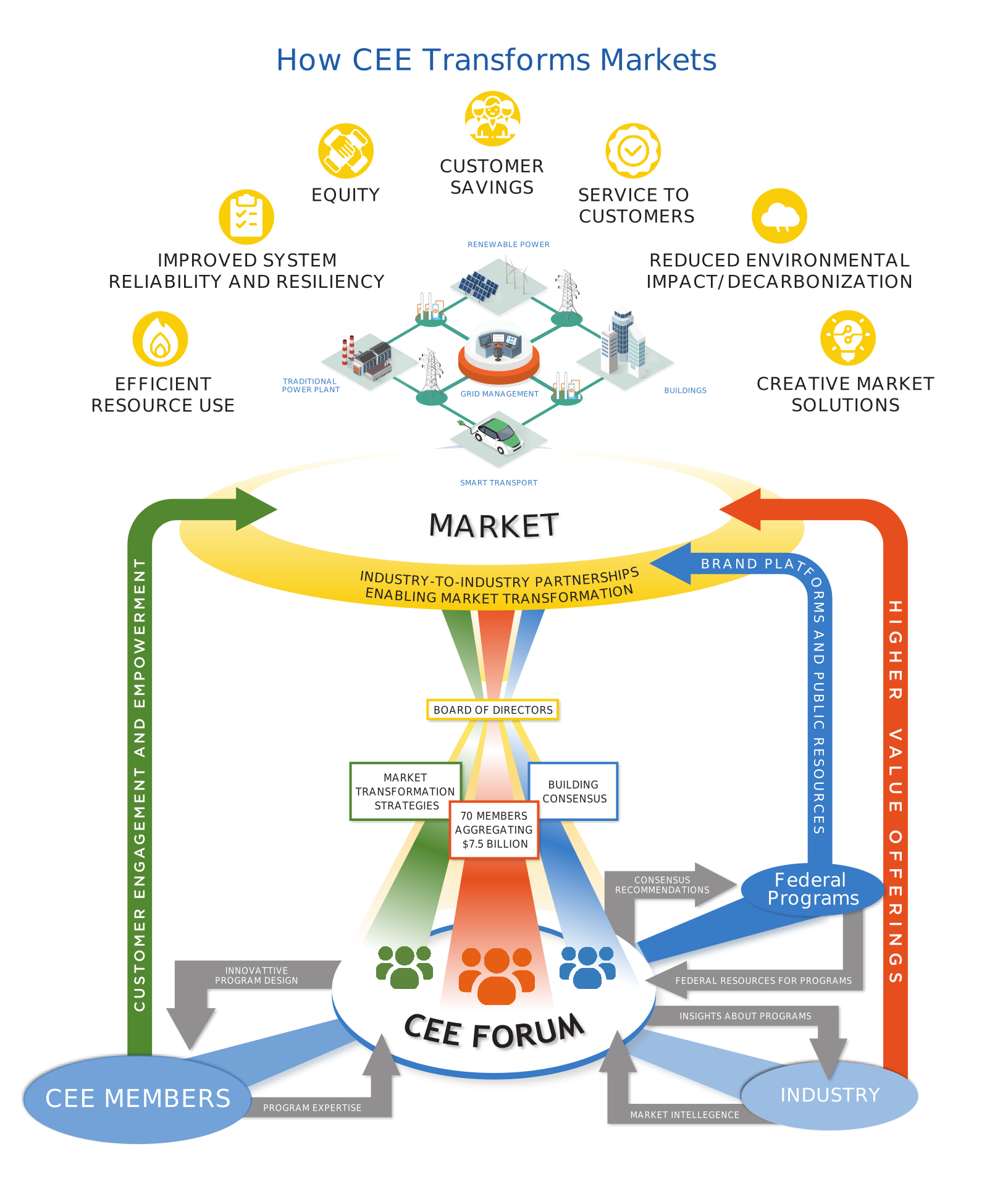
How CEE
Transforms Markets
Utility directors and efficiency advocates developed CEE more than 30 years ago and created models for advancing efficiency at market scale, helping to improve unit performance, program impacts, and cost effectiveness by driving economies of scale in production and market competition. Member efforts crafted important program industry conventions, earned trusted relationships with key manufacturing and trade industries, and established credibility with policy makers and regulatory personnel. Collectively, these important assets work to accelerate new products and services to meet the challenges of tomorrow’s utility systems while serving customer needs today.
Members participate in a trusted work environment, managed to screen private, parochial interests, where team play and identifying shared interests are the norm. This environment fosters mutual trust and respect, allowing frank and productive conversation for practical application, and serves our industry’s goals while edifying the individual participant.
The Consortium manages a community of peers that share the often underappreciated obligations of providing safe, reliable, affordable, clean and equitable energy service. At the Consortium, members work to design and implement market initiatives to serve the highest priority shared needs.
Dual-Fuel Heating Systems

CEE Resources Offer Guidance
for Manufacturers

SECTOR REPORTS
SECTOR REPORTS
Residential

Revised Electric HVAC Equipment Specifications
In October 2024, the CEE Board authorized changes to the CEE Central Air Conditioner (CAC) and Air Source Heat Pump (ASHP) specifications proposed by the Residential HVAC Committee. The revision simplified the specification structure to increase penetration of high performing systems while also acknowledging the need for contractor discretion in the market.
These changes included a shift from two regional specifications to single North American specification that offers two pathways for compliance for the Split ASHP category, addition of an Advanced Tier for Split ASHP that optimizes for cold climate conditions, merging of Split Ducted ASHP and Non-ducted ASHP specification categories to help increase the potential for market adoption, and requirement of demand response starting in 2026 to reinforce a directive for future load flexibility capabilities.
Continued Development of Market Resources to Support Education and Awareness Regarding ASHP Quality Installation
In support of the CEE℠ Residential Heating and Cooling Systems Initiative, CEE continued work with an Advisory Committee consisting of members and invited industry partners on Phase II of the Air Source Heat Pump Quality Installation Business Plan. This project establishes consensus-based market resources that program administrators and other relevant market stakeholders can deploy locally to address some of the persistent challenges around proper selection, design, sizing, installation, commissioning, operations, and maintenance of high-performance air source heat pumps (ASHPs). With input and recommendations from the CEE Portfolio Advisory Committee (PAC), CEE developed and launched a Phase II.I scope of work that outlined two additional deliverables:
- Homeowner Design Decision Matrix and System Design Guide
- Sizing Considerations for Heating and Cooling Guide
Revised Electric Water Heating Specifications
In support of evolving technological and efficiency advancements and increased member interest in demand response programs, the CEE Residential Water Heating Committee developed revised CEE Residential Electric Water Heating Specifications that were authorized by the Board in October 2024. This Initiative revision included citing the AHRI Standard 1430 for load management, required compliance in CEE Tier 1 levels for some categories starting January 1, 2026, and adding an Advanced Tier for split-system HPWHs and 120V HPWHs.
CEE also published an updated version of the CEE Residential Water Heating Initiative: Program Considerations, a resource designed to support program administrators' adoption and participation in the Initiative by sharing successful program models and strategies from across the membership. The 2024 revision included increased focus on load flexible water heater programs and equitable program design considerations.
New CEE Room Heat Pump Specification
CEE continued to establish revisions to the CEE℠ Room Heat Pump Initiative, which aims to encourage manufacturers to design, produce, and effectively promote new-to-market room heat pumps; sustained member participation will support the development and availability of a new product category that will play a crucial role in decarbonizing the multifamily sector and replacing existing window air conditioners and electrical resistance space heaters.
The Committee collaborated regularly with DOE and EPA ENERGY STAR to pursue alignment and coordination of future room heat pump specifications in an effort to help reduce overall market confusion as room heat pumps become commercially available. The Board authorized publication of the first CEE Room Heat Pump specifications in December, 2024. The scope of the approved specification included establishment of three tiers with increasingly stringent levels of performance that deliver efficiency coupled with adequate capacity relative to lower ambient conditions. The efficiency metrics included in the specification are CEER, HEER, COP, and Capacity Ratio. Additional specification components include defrost capabilities, meltwater disposition reporting, and refrigerant global warming potential (GWP) requirements.
CEE explored options for developing and hosting a qualified products list (QPL) for the CEE Room Heat Pump Specification, and have been in conversations with AHRI and DOE about possible coordination, including leverage of DOE's CCMS system and the AHRI Directory.
Execution of 2024 CEE Integrated Home Competition: Focus on Small Loads
The CEE Integrated Home Competition is an annual competition seeking residential or multifamily equipment that supports automated and optimized energy management, including a focus on grid resilience and reliability, and is engineered to create new value for customers. This year marked the fourth formal completion of the annual Integrated Home Competition cycle. In 2024, the Competition focused exclusively on smaller residential loads. Judges evaluated entries in residential connected lighting, plug load controls, home energy management, ceiling fans, window attachments, and an open category for other connected home devices.
Winning entries were promoted and presented awards at several in-person events throughout the year, including the CEE Industry Partners Meeting, AHR Expo, ACEEE Hot Air and Hot Water Forum, National Home Performance Conference, and the annual HARDI Conference.
SECTOR REPORTS
Commercial
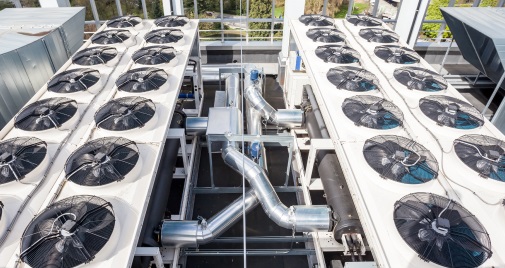
Continued Evolution of Commercial Air Conditioning and Heat Pumps to Meet Diverse Needs and Applications
CEE revised the CEE℠ Commercial Air Conditioning and Heat Pumps Initiative to include new tiers for air-source unitary heat pumps that provide meaningful efficiency gains above baseline technologies. The Committee's work in 2024 largely focused on helping identify the necessary conditions for heat pump adoption in rooftop unit (RTU) applications.
To further this goal, CEE joined the DOE Better Buildings Commercial Building Heat Pump Accelerator as a partner in this shared effort to advance adoption of high performance RTU equipment. The Committee also convened industry partners to identify how CEE and stakeholders can work together to make heat pumps, including dual fuel options, the default offering in RTU applications and develop a roadmap centered on a longer-term product vision for high performance heat pump RTUs.
Deployment of Revised Commercial Water Heating Initiative
Committee work in 2024 focused primarily on supporting the adoption and uptake of the updated CEE℠ Commercial Water Heating Initiative. This included sharing best practices, identifying resources and tools to assist the Initiative objectives, and developing and launching a QPL for models that meet the new specification levels. The CEE specifications and program guidelines focused on helping arm program administrators with the tools and information needed to ensure systems operate at the maximum possible efficiency. Program requirements included sizing methodologies, weight and makeup air considerations, storage tank minimum standby loss requirements and factory commissioning requirements.
Revisions to Commercial Boiler/Hydronic Heating Initiative
The Committee finalized a draft revision to the CEE℠ Commercial Boiler Systems Initiative that evolved the name and subsequent scope to the CEE℠ Commercial Gas-Fired Hydronic Heating Systems Initiative. Proposed changes included retiring Tier 0 for conventional boilers, enhancing the equipment specification's focus on condensing boilers, and adding a product category and Advanced Tier for systems with greater than 100% efficiency (e.g., gas heat pump solutions). Components beyond the equipment specification include requirements for multiple heat engine systems including hybrid, quality installation, maintenance and tune-ups, and operation. The draft Initiative aimed to help energy efficiency programs build and deliver leveraged, informed, and cost-effective commercial gas-fired hydronic heating programs.
Continued Development of Dynamic Energy Management
Committee discussions focused on two areas: (1) Identifying connectivity standards for end-uses which are favorable for providing load-shifting services and (2) researching existing load shifting programs which are experiencing success to leverage proven strategies and determine how they translate into actionable tactics for the DEM committee to pursue. The Committee focus in 2024 was largely on creating specifications for commercial HVAC and water heating systems, as these systems are major energy consumers in commercial buildings and are well-suited for load-shifting services.
The Committee worked to refine draft content for a brand new CEE Initiative that aims to set voluntary specifications and program guidelines to ensure the strategic control of energy-storing and energy-consuming devices, facilitating deeper renewable energy integration and better infrastructure utilization without compromising reliability, safety, or cost-effectiveness.
Launch of a New CEE Income-Qualified Multifamily Subcommittee
CEE launched a new project focused on strategies to accelerate the adoption of integrated whole building measures in the income-qualified multifamily sector. This effort was based on multiple conversations across the membership, including through the Behavior Committee, the Strategic Energy Management Committee, and the Emerging Technologies Collaborative. CEE assessed various building and customer types at the intersection of commercial retrofit decision-making and behavioral social science. Given the membership's priorities and how well CEE would be positioned to address the potential segments, CEE began a new effort focused on multifamily low-income program design in 2024.
The Committee explored prospects to leverage educational components of strategic energy management to coordinate decision-makers and increase participation in deep energy retrofits for income-qualified multifamily audiences. Initial work of this new Committee in 2024 focused the scope at this time to income-qualified, multifamily, tenant-occupied buildings, as they present a particularly challenging landscape of split incentives that make capital investments difficult to financially justify.
SECTOR REPORTS
Natural Gas

Exploration of Gas Demand Response Opportunities
The CEE Natural Gas Strategy Committee continued to examine and identify ways in which demand management concepts can be further explored by gas utilities in North America. This remains an ongoing area of interest and investigation for the Committee.
CEE members contributed examples of gas demand response pilots and programs for an ACEEE Summer Study paper. CEE member GTI Energy presented the CEE paper on gas demand response program findings at the ACEEE Summer Study.
Gas Equipment and Program Solutions in Support of Decarbonization
The Committee continued to focus on the role and opportunity for the Consortium to position natural gas as an active part of the solution to decarbonization, which requires resources as well as policy and regulatory space to enable innovation and ongoing advances in efficiency and performance, especially to optimize combined and interactive gas and electric applications.
CEE held a Natural Gas Summit in September 2024 to discuss the future of gas energy efficiency programs and craft a shared vision. Attendees created a vision for the future of gas energy efficiency programs and provided input to inform the direction of CEE work on gas heat pumps and dual fuel equipment in 2025 and beyond. The Committee also identified the following priorities for collective work together: dual fuel systems, gas heat pumps, and weatherization or gas-adjacent equipment (e.g., controls, heat recovery ventilation).
SECTOR REPORTS
Industrial

SEM Expanded Scope and New Decarbonization Guidance
The Strategic Energy Management (SEM) Committee finalized revisions to the CEE℠ Strategic Energy Management Initiative, supplementing the Minimum Elements with non-prescriptive decarbonization guidance. Based on member input, the Committee researched ways that SEM can be enhanced and further advanced as a framework for addressing greenhouse gas (GHG) emissions reductions in addition to being a system for achieving energy reductions from operational changes. Given shifting emphasis, and in some cases requirements for utilities to achieve decarbonization through their energy efficiency programs, several CEE members have begun to explore or incorporate GHG mitigation into their SEM programs. Staff from Lawrence Berkeley National Laboratory assessed alignment between the CEE SEM Minimum Elements and the 25 tasks in the US DOE 50001 Ready Navigator tool to leverage existing GHG guidance.
The final step of this process was the addition of decarbonization-related data to the CEE 2023/2024 SEM Program Summary. To facilitate this, CEE collaborated with industry partners, namely representatives from the North American SEM Collaborative's decarbonization working group, to expand reach and refine the data collection.
Progressing Shared Understanding of Industrial Heat Pump Definitions and Applications
The CEE Industrial Heat Pump Committee made strides towards achieving its goal of industrial heat pump market transformation in North America. Most notably among these were the finalization of a working definition for "industrial heat pump," the establishment of ongoing collaboration with AHRI on the potential development of standards for industrial heat pumps, and the preliminary identification of process heat uses which present significant opportunity in member service territories.
CEE identified two major activities to pursue in an effort to stimulate the availability of industrial heat pump equipment in the North American market. First, a comprehensive analysis and characterization of the North American industrial heat pump market that demonstrates significant demand is necessary for industry to devote resources to the development of industrial heat pump products. Second, creation of an industrial heat pump specification to codify standard metrics and test procedures (currently in development) and help provide programs with a consistent means for promoting industrial heat pump solutions in the market.
C&I Pump Initiative Revisions Near Completion
The CEE Pump Systems Committee identified an opportunity to update the Initiative and specifications to align with updated federal rules and pull the market toward pumps with controls that can vary load based on application conditions.
The Committee also coordinated internally and through conversations with industry to define levels of performance for circulator pumps, which were not previously covered by DOE or the CEE Initiative. The draft CEE tier levels help pull the market toward higher efficiency ahead of an upcoming DOE compliance date in 2028.
CEE also engaged closely with the Hydraulic Institute at their Fall Meeting to present the draft Initiative and specification updates for initial feedback and to provide notice of the upcoming comment period. The Committee finalized revisions to the Initiative and specification based on the initial industry feedback and sent the proposal to industry for formal comment at the end of 2024.
Exploration of Reinvigorating Motor Efficiency Opportunities
In 2024, CEE began collaborating with staff from the National Electrical Manufacturers Association (NEMA), individual motor manufacturers, and CEE members involved with a coalition of motor industry representatives called the Motor Coalition on potential use of the new NEMA standard and a new CEE Motor Initiative.
SECTOR REPORTS
Evaluation and Research

Continued Efforts to Quantify Non-Energy Impacts (NEIs)
In conjunction with the Center for Equity and Energy Behavior, the Evaluation Committee explored industry efforts to monetize two NEIs (thermal comfort and indoor air quality), both of which were prioritized for their relevance to customers who are underserved and their magnitude of impact.
The Committee refined and finalized the scope of both reports and also explored the design and development of a library containing non-energy impact resources ranging from literature reviews to quantification studies.
Characterization of New Decarbonization Goals and Metrics
The Committee continued to research members' evolving goals and how program administrators are measuring against them, both currently and in the future. CEE designed and launched a survey to understand members' current goals for reporting GHG emissions, methods and tools for measuring against them, and new priorities on the horizon. Initial survey findings were shared and discussed with the Committee and utilized for internal planning efforts.
New Program Summary Dashboard Project
The CEE Research Team worked to develop the CEE Program Summary Dashboard, an online searchable platform with filtering functionality. This new format allows for increased accessibility, engagement, and interaction with program summary information, which includes equipment types, incentive levels, and program designs.
Annual Data and Research Publications
Two mainstays of the CEE research portfolio are the Annual Industry Report and the Member Program Summaries. CEE staff ensured the completion of these two research efforts which serve to paint a picture of the status of the industry on both the macro and micro scales.
CEE completed and published the 2023 Annual Industry Report. This report leveraged data from the American Gas Association (AGA), Efficiency Canada, and the Energy Information Administration (EIA) to scope binational investment in Energy Efficiency and track the aggregate savings of the industry.
CEE published 23 program summaries, including 11 residential programs and six commercial programs for the 2023 program year, as well as six commercial programs for the 2022 program year. These program summaries are a compilation of programs, rebates, and services offered by our members as they relate to our active work areas.
SECTOR REPORTS
Behavior and Equity

Continuation of Behavior Committee Work
The CEE Behavior Committee participated in new efforts focused on particular areas of member interest, including behavioral demand response. As part of this focus, CEE staff participated in a new technical advisory committee led by the Canadian Standards Association (CSA Group) to pursue development of a behavioral energy program standard.
The Committee also explored the role of decision makers in commercial retrofit contexts, specifically as they interact with income-qualified multifamily segments.
In October of 2024, CEE published a key takeaways document summarizing common program learnings gleaned from the 2023 Behavior Program Summary, and an update that included additional program findings.
Progress on Center for Equity and Energy Behavior Deliverables
The Center Advisory Committee (consisting of 16 member sponsors) advanced the work outlined in Year 3 of the Phase I Business Plan and discussed the scope for Phase II of the Center. In 2024, the Center published four deliverables:
- A series of Equity Case Studies, highlighting three equity efforts across member organizations: a microbusiness effort at Avangrid, a geotargeting initiative at DTE aiming to better engage energy burdened customers, and a workforce development program led by Eversource and other Mass Save utilities.
- A set of Equity Recommendations for CEE Initiatives, providing action based, high-level recommendations for program administrator consideration to ensure more equitable program design and efficient equipment installation efforts when leveraging partnerships with key stakeholders along the supply and distribution chain.
- A Report for Equitable Engagement, detailing a comprehensive overview of equity learnings from the entirety of Phase I, including a recommended process to follow to more effectively design and implement energy efficiency programs for priority audiences, informed by collectively-vetted social science best practice.
- Two Non-Energy Impact Reports, one each on thermal comfort and indoor air quality, including a range of monetized values, a synthesis of evaluation methodologies, and a gap analysis.
In June, the United States (led by CEE Center staff) convened a Hard-to-Reach Workshop focused on better elevating Indigenous voices in program design and deployment and facilitated by Indigenous community members from across the United States, Canada, and New Zealand.
SECTOR REPORTS
Emerging Technologies Collaborative

Preliminary Research and Roundtable Discussions
In 2024, the ETC Advisory Committee selected the following five emerging opportunities to conduct Preliminary Research Reports for:
- Nonresidential Secondary Windows and High-performance Primary Windows
- Smart Panel and Smart Circuit Solutions
- Residential Induction Cooking Equipment (120V, Integrated Battery Storage)
- High-Temperature Air-to-Water Heat Pumps
- Emerging Aspects of Residential Variable Speed Heat Pumps for HVAC
Extended Research: Emerging Aspects of Residential Integrated HVAC Controls
The ETC Advisory Committee selected this opportunity to further appreciate what is currently available in the market, develop strategies for optimal system configurations, and address barriers impacting dual fuel systems. The primary goal of integrated HVAC control technology is to optimize the use of multiple heating and cooling systems to achieve comfort and energy objectives. The Working Group convened to develop scope for the project workplan, determine important features, identify key partners, and understand the current landscape for these controls.
2024 Catalog of Emerging Opportunities Assessments
Each year, ETC members contribute any new emerging opportunity assessments that they may have conducted within their organizations over the past year to the ETC Catalog and update the status of assessments that they had contributed to the Catalog in prior years.
CEE released an updated 2024 Catalog that contains 72 new assessments, bringing the total number of assessments collected from contributing sponsors in the United States and Canada since 2011 to 1,793.
Financials
2023 Financials (Audited)
Statement of Financial Position
Assets
| Cash and investments | $3,645 |
| Government grants and memberships receivable | $432 |
| Fixed assets, net of depreciation | $420 |
| Other assets | $66 |
| Total assets | $4,563 |
Liabilities and net assets
| Current liabilities | $697 |
| Long-term liabilities | $202 |
| Unrestricted net assets | $2,838 |
| Temporarily restricted net assets | $826 |
| Total liabilities and net assets | $4,563 |
Statement of Activities
Revenue and support from operations
| Membership dues and government grants | $2,838 |
| Net assets released from restrictions | $757 |
| Other income | $146 |
| Total revenue and support from operations | $3,741 |
Operating expense
| Program | $2,608 |
| Administration | $1,039 |
| Total operating expenses | $3,647 |
Nonoperating activities
| Increase (decrease) in net assets from operations | $94 |
| Unrealized gain on investments | $123 |
| Total increase (decrease) in net assets | $217 |
| Net assets, beginning of year | $3,447 |
| Net assets, end of year | $3,664 |
All numbers are in thousands.

The Consortium for Energy Efficiency is a group of North American utility energy efficiency program administrators. For more than 30 years, Consortium members have developed cutting-edge strategies to accelerate the commercialization of energy efficient solutions to benefit gas and electric customers, utility systems, and the environment. In this work, CEE has successfully engaged with leading manufacturers, trade associations and other market stakeholders to develop win/win solutions that benefit all. Consortium work is guided by Initiatives that members voluntarily implement.
© 2013–2024 Consortium for Energy Efficiency, Inc. All rights reserved. Terms and conditions for use of this website.